Why spending feels like relief (and then regret)
The cart fills when something inside feels empty. For a moment spending helps — then the package arrives and the relief is already gone.
By Trupti Gavit
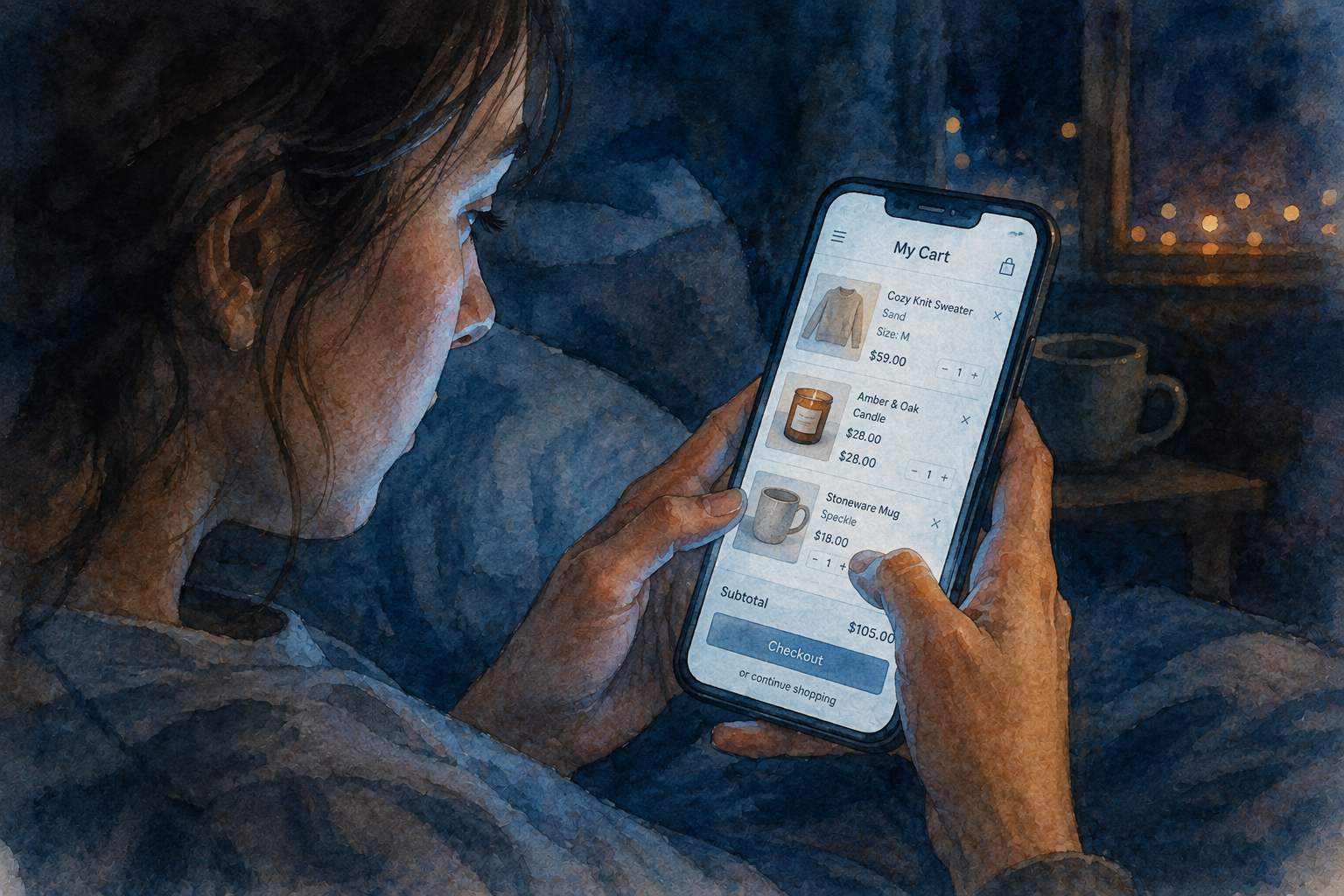
It's Tuesday night. You're on the couch with your phone, scrolling. Not shopping, exactly. Just looking. Just browsing.
And then you see it. The thing that will solve the problem you didn't know you had. The sweater that will make you feel put-together. The kitchen gadget that will make you the kind of person who makes fresh pasta. The book that will finally be the one that changes everything.
You add it to the cart. Then another thing. Then another.
Your chest loosens. Your breath slows. For the first time all day, something feels like it's moving in the right direction.
You check out. Free shipping. The dopamine hits. You close the app.
And for a few minutes—maybe an hour, maybe until morning—you feel better. Lighter. Like you just solved something.
Then the package arrives. You open it. The sweater doesn't fit right. The gadget sits in the drawer. The book joins the stack by your bed that you'll get to someday.
And the feeling you were trying to soothe? It's still there. Exactly where you left it.
The relief that isn't about the thing
Here's what's happening in that moment on the couch: you're not actually shopping. You're soothing.
Something inside feels tight, or empty, or out of control. Maybe it's a hard day at work. Maybe it's a fight with your partner. Maybe it's just the low hum of stress you've been carrying for weeks and can't quite name.
And spending—clicking, adding, imagining the better version of yourself who owns that thing—gives you a tiny hit of control. Of progress. Of doing something that makes you feel like you're taking care of yourself.
Except you're not. You're just moving the feeling somewhere else.
You're not spending because you need the thing. You're spending because needing feels unbearable, and buying feels like an answer.
The cart fills when something inside feels empty. And for a moment, it works. You feel the relief of solving a problem, even though the problem wasn't "I don't own this sweater." The problem was "I feel bad, and I don't know how to feel better."
But spending doesn't touch that. It just covers it. Briefly.
Why the regret comes so fast
You know the pattern by now. You spend. You feel better. The thing arrives. And almost immediately, the relief is gone, and the regret kicks in.
Not because you're bad with money. Not because you're impulsive or reckless or out of control.
Because the thing you bought was never the thing you needed. It was a stand-in. A placeholder for comfort, or safety, or the feeling that someone's taking care of you.
And when the package shows up and it doesn't deliver that? Of course you feel regret. Of course you feel like you wasted money. Because you were trying to buy relief, and relief can't be shipped.
But here's the part that hurts: the regret doesn't stop you from doing it again. Because the next time you feel bad, your brain remembers that brief moment of relief, and it says, "That helped last time."
Except it didn't. It just distracted you. And now you're stuck in a loop: spending to feel better, regretting the spending, feeling worse, spending again to feel better.
The cycle doesn't stop because you lack willpower. It stops when you start asking what you're really trying to soothe.
Spending isn't the problem. It's a symptom. The question isn't "Why do I keep buying things?" It's "What am I trying to soothe?"
What spending is standing in for
Let's get honest about what you're actually reaching for when you reach for your wallet.
Maybe it's control. Maybe your life feels chaotic, or overwhelming, or like it's happening to you instead of something you get to shape. And spending—deciding, choosing, clicking—gives you a tiny pocket of autonomy. A place where you get to say yes to something, even if it's just a candle.
Maybe it's comfort. Maybe you grew up without enough, and buying things now feels like evidence that you're safe. That you've made it. That you won't go back to that place where you couldn't have what you needed.
Maybe it's care. Maybe no one's checking in on you. Maybe you're tired of being the one who takes care of everyone else, and buying something for yourself is the only way you know how to say, "I matter too."
Or maybe it's distraction. Maybe sitting with how you actually feel is too hard, too big, too much. And scrolling through products is easier than sitting with the ache.
None of that is a flaw. It makes you human.
But it does mean that if you want the cycle to change, you have to stop trying to change the spending first — and start looking at what the spending is trying to soothe.
What your body is doing
Here's the part that makes this harder than it should be: spending activates the same relief response in your body as actual safety.
When you're stressed, your body is looking for a way to settle. To feel like things are okay again.
And buying something—especially something that promises to make your life better, easier, more beautiful—gives your brain a hit of "problem solved." Your system gets a brief message: "We're taking care of this. We're handling it. We're okay."
Except you're not handling it. You're just delaying the feeling.
And when the thing arrives and it doesn't ease the stress, doesn't make you feel held, doesn't solve the thing you were really worried about? Your body goes back into alert mode. The relief was fake. The problem is still here.
So you spend again. Because your body remembers that moment of relief and wants it back.
That's not a character flaw. That's your body doing what it was designed to do: find relief wherever it can. It just hasn't learned yet that this kind of relief doesn't last.
Your body isn't wrong for seeking relief. It's just looking in the wrong place.
The pause that changes everything
You don't have to stop spending. You don't have to shame yourself or lock your credit cards in a drawer or swear off online shopping forever.
You just have to practice pausing.
Next time you're on your phone, cart full, finger hovering over "checkout," stop. Don't close the app. Don't delete the cart. Just stop.
And ask yourself: "What am I actually feeling right now?"
Not what you're thinking. Not what you're trying to soothe. What you're feeling.
Are you lonely? Exhausted? Overwhelmed? Sad? Angry? Numb?
Just name it. You don't have to solve it. You don't have to make it go away. You just have to name it.
And then ask: "Is this purchase going to ease that feeling?"
Not "Is it worth it?" Not "Can I afford it?" Just: "Will this ease what I'm actually feeling?"
Most of the time, the answer is no.
And that's okay. You don't have to delete the cart. You don't have to never buy the thing.
You just have to notice that you're using spending as a stand-in for something else. You just have to see the pattern.
Because once you see it, you can start to interrupt it. Not by willpower. Not by restriction. Just by asking what you actually need, and whether the thing you're about to buy can give it to you.
Spending isn't the whole story. Money isn't the problem. The problem is that you learned to use buying as a way to soothe something that can't be soothed with stuff.
And that's not your fault. But it is something you can notice.
Not by spending less. Not by restricting yourself or setting stricter budgets or feeling ashamed every time you want something.
By learning to pause — to ask what you're really reaching for. To wonder what you actually need. To find relief in places that last longer than the two-day shipping window.
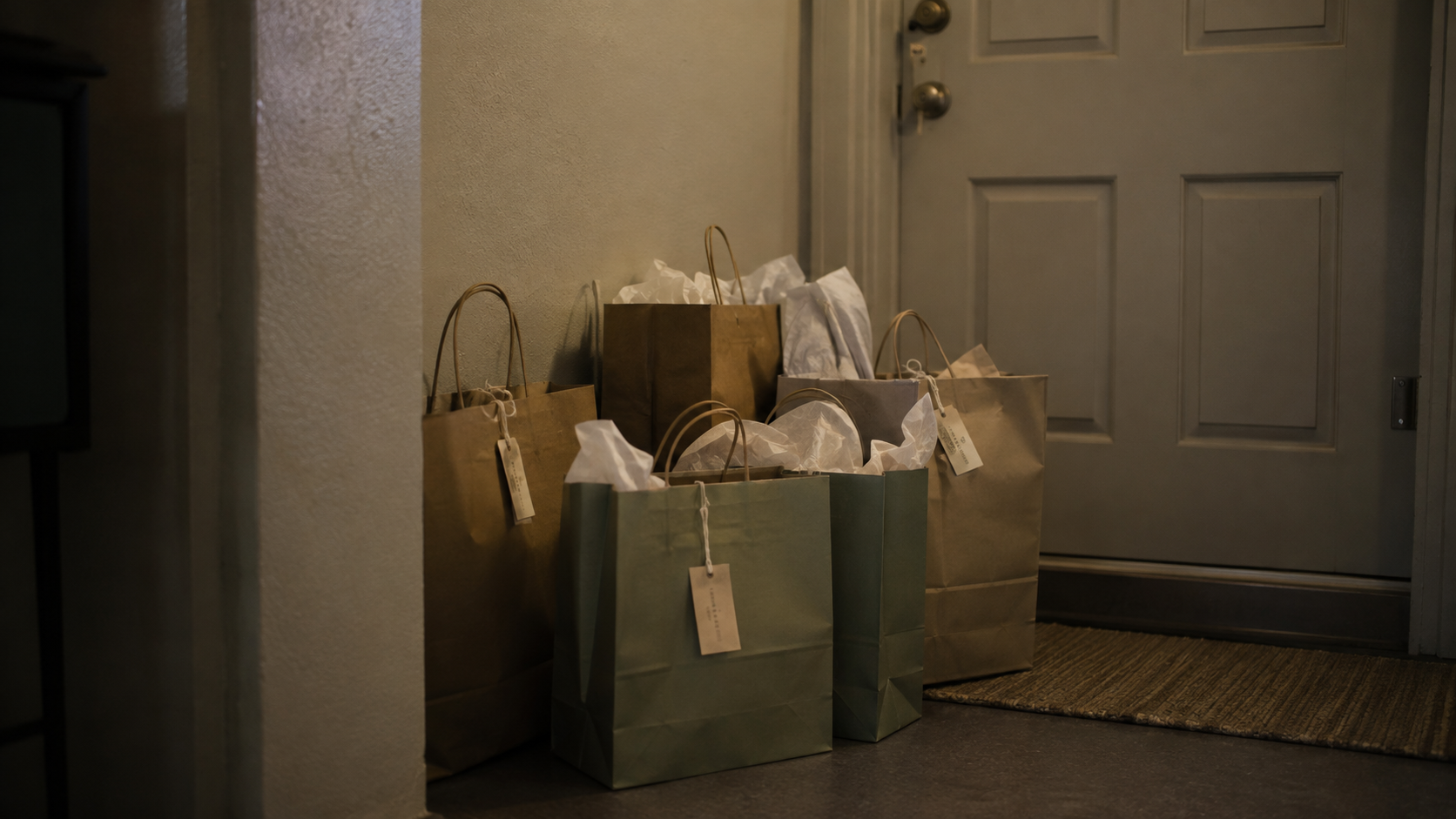
The bags might still sit by the door, tags on. The cart might still be full on a Tuesday night. And maybe, one of those nights, you close the app without checking out. Maybe you don't.
Either way, the feeling you were shopping for is still there, waiting to be named.
Related book
Why Money Hits So Deep
Keep reading
- How to receive help without feeling like a burdenWhen someone offers help and your first instinct is to refuse—even though you need it—and what that reflex is protecting.
- You're not behind — you're on a different pathEveryone else seems on schedule while you're still figuring it out. There is no schedule — just your life, unfolding the only way it could.
- Why you always expect the worstWhen good news arrives and some part of you is already bracing for it to fall apart—and what that habit is really protecting.